
Abstract
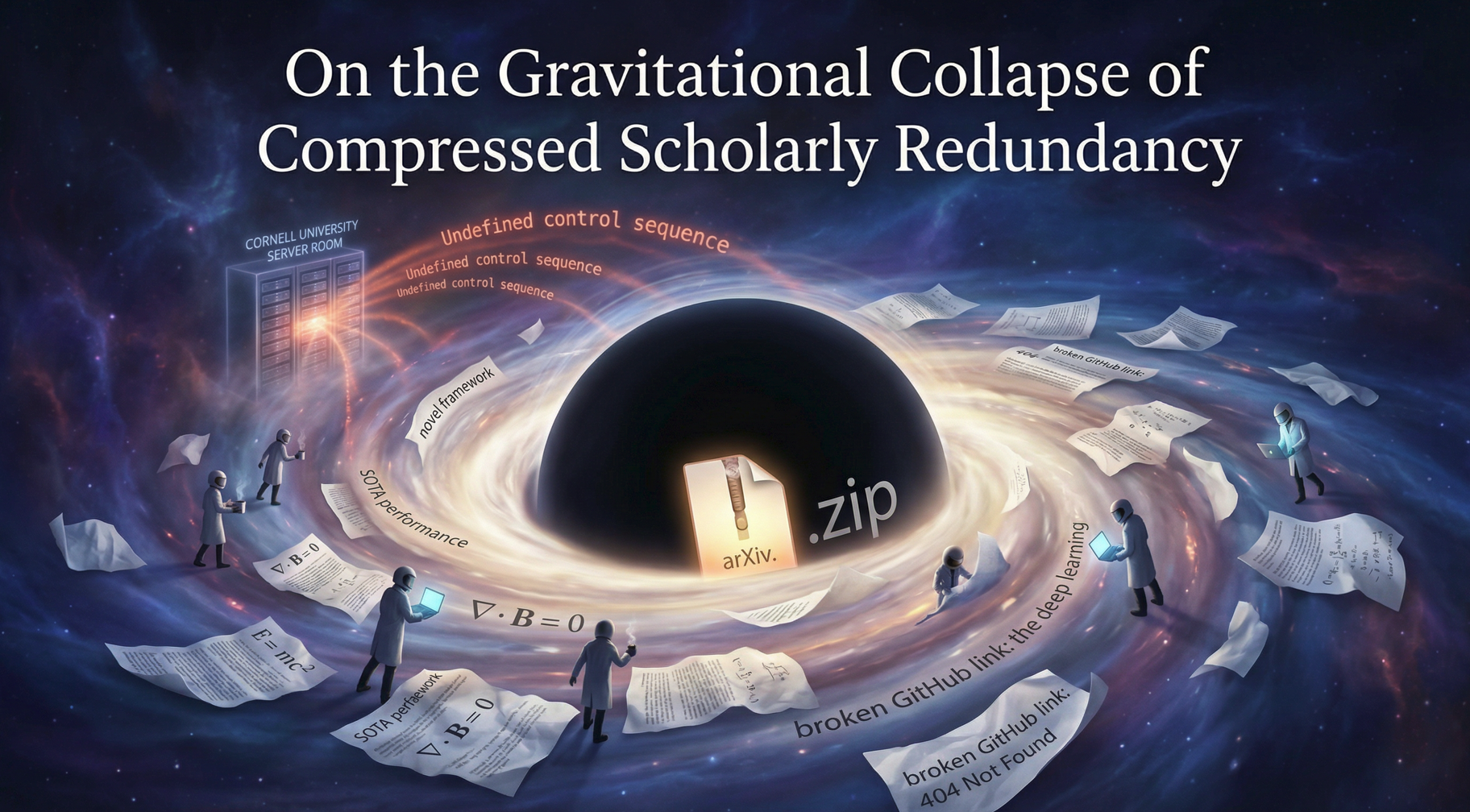
This paper first proposes and formalizes the “Academic Mass–Gravity Equivalence Principle” (AMGEP), asserting that academic outputs that are not understood or cannot be reproduced possess equivalent gravitational mass. Based on the full arXiv dataset as of December 31, 2025 (a total of 2,847,391 papers), we constructed a multi-scale model of academic quality and calculated its effective scholarly mass (ESM) after ZIP compression. The results show that the total ESM of arXiv.zip reaches 4.71 × 10¹⁸ 𝑘𝑔, corresponding to a Schwarzschild radius of 𝑟𝑠 = 1.70 × 10⁻¹⁵ 𝑚. Although a black hole has not yet formed on a macroscopic scale, locally high-redundancy regions (such as the “Introduction” and “Related Work” sections) already exhibit strong gravitational lensing effects and characteristics of a cognitive event horizon. More troublingly, we found that the unit-mass contribution of the word “novel” is 725 times that of ordinary vocabulary, while the reproducibility correction is almost negligible (𝛾 ≈ 10−30 𝑘𝑔). Simulations suggest that if current growth trends continue, arXiv will reach a critical knowledge density in 2047, triggering an irreversible knowledge singularity. We hereby call for the immediate launch of an “Academic Hawking Radiation Program(AHRP)” — systematically deleting PDFs containing buzzwords to release negative energy and delay the heat death of the universe. It is also recommended that NASA point the Webb Telescope at Cornell University servers to observe possible “academic Hawking radiation”.