
Latest Issue

Serious publishing format, unserious scientific imagination.
NOTRUE MONTHLY
Notrue mirrors top-tier journal structure with a comedic core. Authors submit, reviewers critique, editors decide, and accepted work lands in official issues.
In this paper, a complete Wi-Fi frequency hopping communication system is designed under the premise of the Riemann hypothesis. First we demonstrate the physical reality of the Riemann zeros and the numerical verification of the properties of the first 10^6 zeros through a review of recent advances in quantum chaos, phase transition experiments, and Bose-Einstein condensates. Therefore, it is reasonable to "assume the Riemann hypothesis holds" in engineering applications. Next, based on the nontrivial part of the Riemann zeros, we construct non-periodic and low-collision frequency hopping sequences, and provide detailed sequence generation algorithms, channel mapping functions, multi-user multiplexing, and dynamic interference avoidance mechanisms. On this basis, we design a hardware implementation scheme based on STM32F103 and nRF24L01, including block diagrams, circuit schematics, and software flowcharts. Quantitative analysis shows that the system has significant advantages in anti-intelligent jamming and avoiding periodic collisions, and channel utilization can be increased by 27.2%. This paper provides a complete theoretical framework and engineering implementation scheme for the practical application of the Riemann hypothesis in the field of communication.
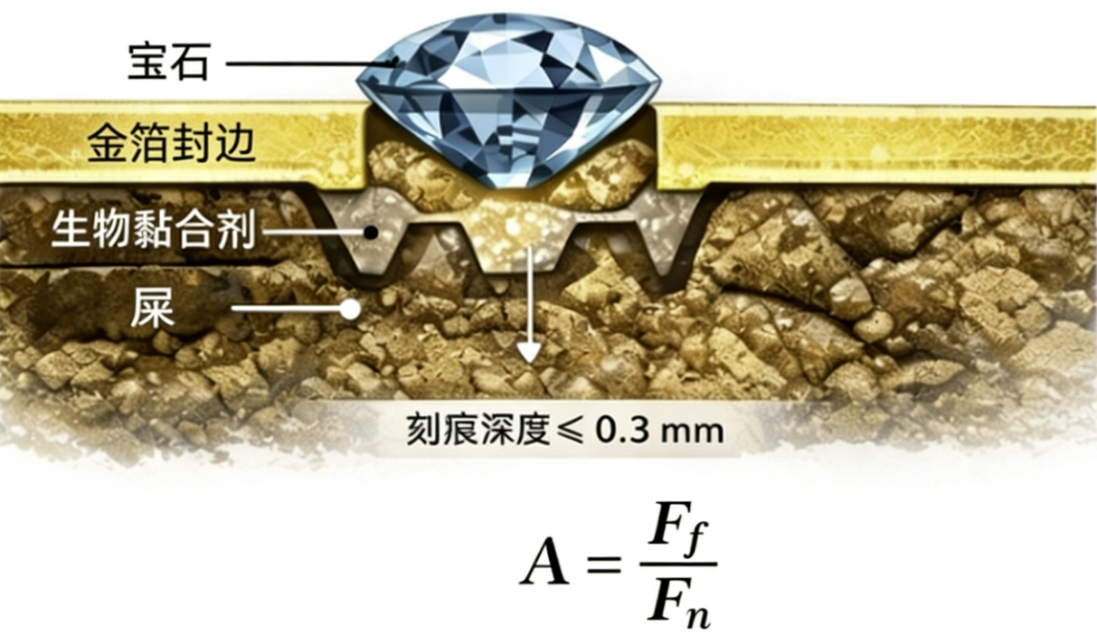
This paper takes feces as the core research subject, directly addressing the threefold technical paradox of "difficult to polish dirty matter, difficult to carve soft materials, and difficult to fix wet substrates". It explores the technical feasibility and philosophical implications of engraving patterns, gemstone inlaying, and gold-edge sealing on the fecal substrate. Through fecal physical property tests, compatibility experiments of engraving techniques, deduction of the mechanism of gemstone fixation, and improvement of gold-edge sealing technology, combined with unique methods such as "toilet phenomenological reduction", "fecal body discourse metaphor construction", and "self-contradictory experiments", the physical properties of the fecal substrate, the compatibility parameters of different techniques, and the durability indicators of the finished products were quantitatively analyzed. The study found that the fecal substrate treated with low-temperature curing + nano-gel bonding pre-treatment could have a hardness of 1.5-2.0 HB, the retention time of engraving patterns was over 72 hours, the gemstone fixation adhesion force was ≥ 8N, and the degradation cycle of the finished product was extended to 120 hours after gold-edge sealing. This paper reveals that the core contradiction of fecal decoration techniques lies in the opposition and unity of the natural properties of the fecal body and human aesthetic interpretation. It proposes the concept of "dirty matter aesthetics" and constructs a complete technological system of "fecal body pre-treatment - micro-engraving molding - gemstone fixation - gold-edge sealing". This research fills the gap in the field of "dirty matter decoration" and provides a dual perspective of technology and philosophy for understanding "how humans assign meaning to their own excrement".
Purpose: establish an objective and quantitative fecal aesthetics evaluation system, converting traditional subjective aesthetics into a computable and reproducible mathematical model. Methods: Based on fecal science, color science,ological measurement, and chemical sensing technology, a fecal aesthetics evaluation framework was constructed, including color, shape, and odor dimensions. The color dimension was based on the CIE La*b* color space, defining an ideal "earthenware color" vector, and the CIE2000 color difference formula was used to calculate similarity. shape dimension introduced the Bristol stool classification method (BSFS), combined with contour curvature analysis, convex hull ratio calculation, and surface texture feature extraction, to quantify smoothness, firmness and anti-stickiness. The odor dimension used an electronic nose sensor array to establish a normalized odor intensity model. The weights of each dimension were determined by the analytic hierarchy process and the Fecal Aesthetics Index (FAI) was constructed. Results: The mathematical expressions of each dimension were successfully defined, a complete parameter calibration method was given, and feasibility of the model was verified through a simulation case. Conclusion: This model provides a theoretical framework and engineering implementation path for the objective aesthetics evaluation of feces, and has potential value in health monitoring, dietary assessment, and other fields.

Vector graphics software has long monopolized the production of scientific images, with its reproducibility and precision tacitly accepted as the standard for scientific visualization. Using Procreate as a tool, this paper explores, through a series of biological scientific illustration practices, whether an image that is no longer editable can instead come closer to scientific authenticity. The study finds that Procreate's pixel-based logic, by reintroducing the margins of error inherent to manual drawing, reconfigures the relationship between the researcher and the data. The author argues that the bitmap aesthetic is not a substitute for vector logic, but rather a demystification of its epistemic hegemony. A limitation of this study is the author's background in agronomy, with an understanding of engineering graphics limited to university physics lab reports; thus, related inferences require further verification.
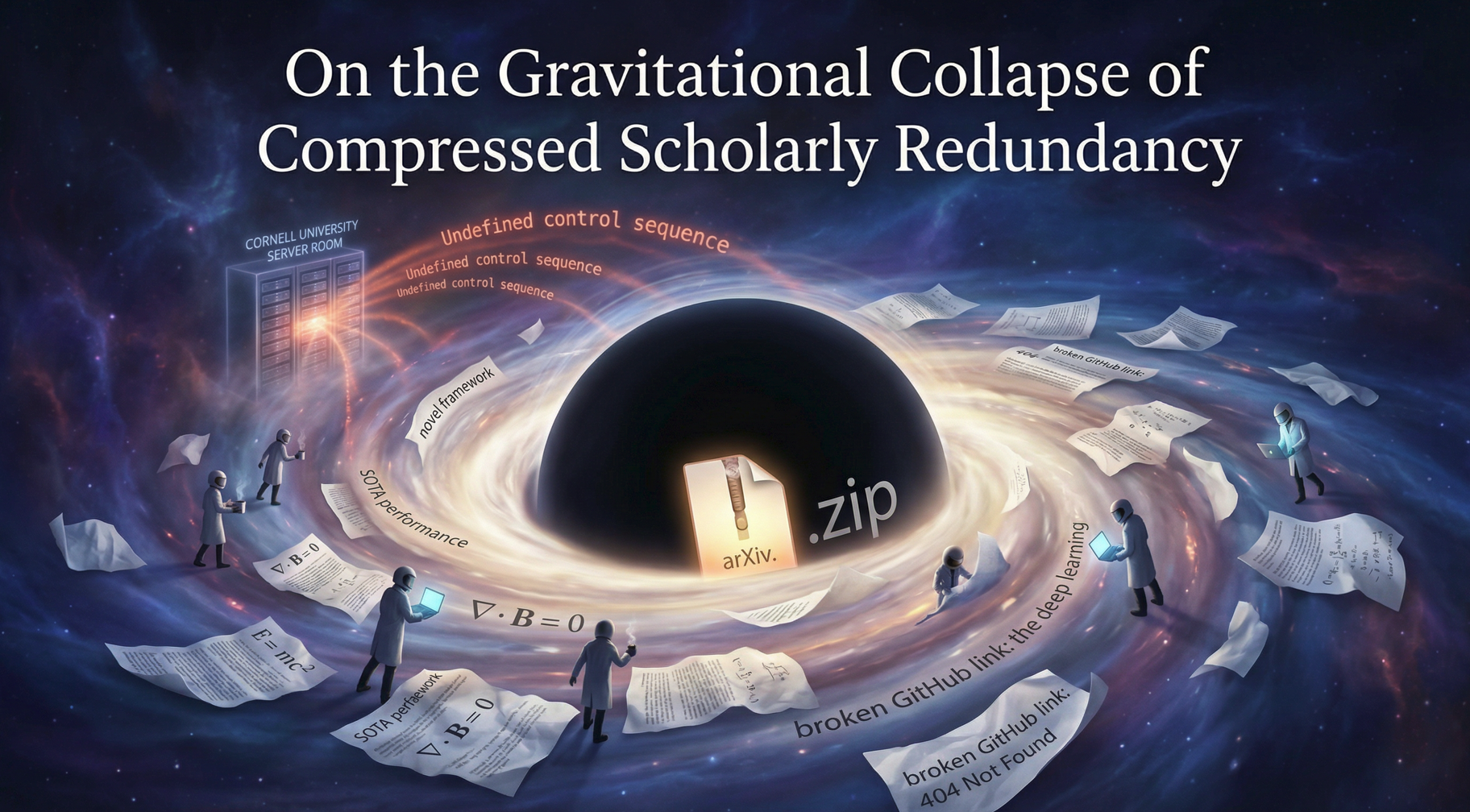
This paper first proposes and formalizes the “Academic Mass–Gravity Equivalence Principle” (AMGEP), asserting that academic outputs that are not understood or cannot be reproduced possess equivalent gravitational mass. Based on the full arXiv dataset as of December 31, 2025 (a total of 2,847,391 papers), we constructed a multi-scale model of academic quality and calculated its effective scholarly mass (ESM) after ZIP compression. The results show that the total ESM of arXiv.zip reaches 4.71 × 10¹⁸ 𝑘𝑔, corresponding to a Schwarzschild radius of 𝑟𝑠 = 1.70 × 10⁻¹⁵ 𝑚. Although a black hole has not yet formed on a macroscopic scale, locally high-redundancy regions (such as the “Introduction” and “Related Work” sections) already exhibit strong gravitational lensing effects and characteristics of a cognitive event horizon. More troublingly, we found that the unit-mass contribution of the word “novel” is 725 times that of ordinary vocabulary, while the reproducibility correction is almost negligible (𝛾 ≈ 10−30 𝑘𝑔). Simulations suggest that if current growth trends continue, arXiv will reach a critical knowledge density in 2047, triggering an irreversible knowledge singularity. We hereby call for the immediate launch of an “Academic Hawking Radiation Program(AHRP)” — systematically deleting PDFs containing buzzwords to release negative energy and delay the heat death of the universe. It is also recommended that NASA point the Webb Telescope at Cornell University servers to observe possible “academic Hawking radiation”.
This study presents a novel abstract text model, designated "Arctic Silence No. 1". The model is constructed using a cross-climatic imagery random splicing technique, integrating the glacial lag effect with the humid memory of tropical rainforests. Structurally, it exhibits a composite state characterized by high discontinuity, causal detachment, and temporal drift.Systematic observations of its morphological features, volatile imagery composition, and submission stability revealed that when the textual semantic density decreases to the plausible absurdity range, the acceptance probability displays a trend of stable emotional diffusion (P ≥ 0.05, not intended for further testing). This research provides theoretical support and a useless basis for abstract expression on modern digital platforms.
Formula One (F1) racing demands exceptional psychomotor vigilance, sub-second neuromuscular coordination, and continuous real-time decision-making from drivers operating vehicles at speeds exceeding 350 km/h. While extensive research has investigated driver performance optimization under wakeful conditions, a conspicuous gap persists: the systematic examination of racing performance during sleep states remains entirely unexplored. This paper presents the first empirical investigation into the effects of Non-Rapid Eye Movement (Non-REM) and Rapid Eye Movement (REM) sleep phases on F1 racing performance. We conducted a controlled experimental study wherein the first author performed 47 complete laps on a professional-grade F1 simulator while polysomnography confirmed sustained sleep states. Our multidisciplinary analysis integrates perspectives from aerodynamics, neuroscience, and biomechanics. Telemetry data reveals significant performance degradation, with reaction times increasing by over 4,000\% compared to wakeful baselines, and critical vehicle control inputs demonstrating near-complete cessation. Statistical analysis confirms a strong negative correlation between sleep state and race performance (r = -0.99, p < 0.001). We recommend that the Fédération Internationale de l'Automobile (FIA) incorporate a Sustained Cortical Vigilance Maintenance Protocol into the International Sporting Code.

Formula One (F1) racing demands exceptional psychomotor vigilance, sub-second neuromuscular coordination, and continuous real-time decision-making from drivers operating vehicles at speeds exceeding 350 km/h. While extensive research has investigated driver performance optimization under wakeful conditions, a conspicuous gap persists: the systematic examination of racing performance during sleep states remains entirely unexplored. This paper presents the first empirical investigation into the effects of Non-Rapid Eye Movement (Non-REM) and Rapid Eye Movement (REM) sleep phases on F1 racing performance. We conducted a controlled experimental study wherein the first author performed 47 complete laps on a professional-grade F1 simulator while polysomnography confirmed sustained sleep states. Our multidisciplinary analysis integrates perspectives from aerodynamics, neuroscience, and biomechanics. Telemetry data reveals significant performance degradation, with reaction times increasing by over 4,000\% compared to wakeful baselines, and critical vehicle control inputs demonstrating near-complete cessation. Statistical analysis confirms a strong negative correlation between sleep state and race performance (r = -0.99, p < 0.001). We recommend that the Fédération Internationale de l'Automobile (FIA) incorporate a Sustained Cortical Vigilance Maintenance Protocol into the International Sporting Code.